
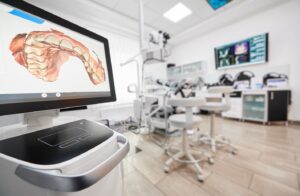
Getting a dental crown, bridge, veneer, or other restoration often requires your dentist to create a detailed model of your teeth. Traditionally, this involved biting into a tray filled with impression material. Today, many dental practices use digital impression systems to capture highly detailed images of teeth and gums. But do digital impressions actually lead to better-fitting restorations? Let’s dive into it!
Greater Precision
A great advantage of digital impressions is their ability to capture detailed information about the shape and position of your teeth. An intraoral scanner uses a small handheld device to create a three-dimensional digital model of your mouth.
Instead of relying on a physical impression that could contain bubbles, distortions, or other imperfections, digital scanning allows the dentist to immediately view the captured image. If an area isn’t clear, the dentist can rescan it rather than sending an inaccurate impression to the dental laboratory.
A Better Fit
The accuracy of the impression is an important part of creating a well-fitting restoration. Digital impressions can provide precise information that helps a dental laboratory design a restoration that closely matches the prepared tooth and surrounding teeth.
A well-fitting crown or bridge can improve comfort, function, appearance, and the restoration’s ability to seal the tooth. Digital impressions can also help the dentist evaluate the bite and make adjustments to the restoration’s design before it is produced.
However, a digital impression isn’t a guarantee of a perfect restoration. The dentist’s preparation of the tooth, the scanning technique, the quality of the equipment, and the laboratory’s fabrication process all play important roles.
More Comfortable for Patients
Digital impressions aren’t just about accuracy. They can also make the experience more comfortable. Traditional impression trays with their messy, sticky molds can feel bulky and may trigger a gag reflex in some patients. Digital scanning eliminates the need for impression material in many situations.
The scanner is moved around the mouth to capture images, making the process relatively quick and noninvasive.
Faster Communication
Digital impressions can also streamline communication between the dental office and laboratory. Instead of shipping a physical impression, the dentist can electronically send the digital file to the laboratory almost immediately. This can help make the restoration process more efficient.
Digital impression technology is an important advancement in restorative dentistry and can contribute to accurate, comfortable, and efficient treatment. If you’re considering a crown, bridge, veneer, or another restoration, ask your dentist whether digital impressions are available and whether they are appropriate for your treatment.
About the Practice
Pinkerton Dental Group in Derry, NH features advanced dental technology, including a digital impression system, not so we can brag about our amenities, but so that we’re able to give our patients better dental care. Equipment like CT/cone beam scanners, digital X-rays, and soft tissue lasers allow for efficient, precise treatment, and in many cases, a more comfortable experience for the patient. Visit our website for more information on our services or call (603) 434-0040.